Thursday, August 8, 2013

The Haw River Farmhouse Ales Family Just Got a Little Bigger!

(Insert low quality MIDI file of the sound of glorious trumpet fanfare here!)
In preparation for opening one of North Carolina’s newest truly Southern-style breweries later this year, Haw River Farmhouse Ales owners Ben Woodward and Dawnya Bohager are proud to announce that Nick Mangili has been brought on as head brewer! Mangili, a Durham native, is returning to North Carolina after “sowing his wild oats” as head brewer at Deep Ellum Brewing Co. in Dallas, Texas. He also spent time helping Fullsteam get started in Durham in 2010.
Mangili is a mix of beer nerd, science geek and farmhand. Pair his stellar brewing experience with a Bachelor of Science degree in biological systems engineering from Virginia Tech and involvement with farm projects — he’s a perfect fit for Haw River Farmhouse Ales.
“We’re focused on sourcing fresh ingredients from local farmers to brew a lineup of truly 'North Carolina' beer,” says Woodward. “Nick’s passion for North Carolina agriculture really sets him apart. He understands our dedication to the community around us — we’re gathering fresh, locally-grown ingredients to make the best, most creative Belgian-inspired beers possible. Nick is going to be an integral part of this process.”
Mangili has some of the same passions. “There are so many things about Haw River that make it an ideal place for me. We’re going to make beer that brings in a Belgian influence and ties into North Carolina. It’s why I want to work with Ben and Dawnya,” says Mangili. “Brewing is a career where you can tie in weird science stuff and help incorporate community as part of the process. It’s an ideal situation for me; a journey I’m excited to take with Haw River Farmhouse Ales.”
Haw River Farmhouse Ales is scheduled to open later this year in Saxapahaw, NC in the dye building at the historic Dixie Yarns Cotton Mill. For more information about upcoming events, brewery opening and Haw River’s unique brews, visit the Haw River Farmhouse Ales website.
# # #
About Haw River Farmhouse Ales
Haw River Farmhouse Ales crafts special brews steeped in Belgian tradition, but elevated by local creativity and Carolina pride. From barley and wild yeast to honey and fruit, the Haw River Farmhand Exchange program sources everything possible from farms within 100 miles of the Saxapahaw, NC brewery. Several Haw River beers also include native wild yeast that the brewery harvested from under a tree in Saxapahaw.
Owners Ben Woodward and Dawnya Bohager believe beer is more than just something you drink. It's an experience meant to be shared with those around you—it's about community. The brewery is scheduled to open in late 2013. For more information visit hawriverales.com.

Thursday, May 16, 2013

Hey Homebrewers! Let's Get Wild!

UPDATE (5/21/13): Last Friday morning, when we announced our Native Yeast Homebrew Competition and opened up registration around 10am, we couldn't have imagined we'd have all 40 spots reserved before folks basically got back from lunch that day. So we're opening up 40 more spots THIS FRIDAY (5/24) MORNING AT 10AM.

The link to the registration page won't allow you to register until 10am on Friday, so if you're interested in reserving a spot, make sure to bookmark this page (or the registration page itself) and revisit on Friday morning. And if you don't catch a spot on Friday, don't sweat it too badly—we're planning another competition this fall, and more than likely it'll be style-based and BJCP-sanctioned, if that sounds more interesting to you. Thanks for all the support, by the way!

. . .

As many of our friends and followers know, we've recently collected, isolated and banked our very own native yeast strain from right here in Saxapahaw, and we've been letting it stretch its legs in a few internal test batches we've brewed, as well as a commercial beer called Little Miss NC that we recently collaborated on with Trophy Brewing Company.

Little Miss NC, in all her stunning glory,
atop the bar at Trophy Brewing Company in Raleigh, NC.

So far, we've been thrilled with how our little Saxapahaw yeast strain has performed. It's played wonderfully in test batches of a Belgian Blonde, a Saison and a Belgian-style Tripel that we've brewed here. If we give it the right malt bill, it flocculates beautifully, leaving a crystal clear beer after about 20-30 days (although it finishes out a ~1.060 wort in about half that time). Again, assuming we want it to, it can attenuate at room temperature quite easily, leaving a clean, crisp, dry beer.

But what happens when we ferment is cooler than 68˚F? How do the flavors meld with roasted malts? What happens when it's pitched into a more fermentable wort? A less fermentable wort? A wort with a low pH? An original gravity over 1.100? A copious amount of crystal malt? A highly hopped India Pale Ale? Oh, the humanity!

We'd love to test out all these scenarios, but we're planning on being busy building a brewery this summer. ;) So we're teaming up with our friends at NCHomebrewing.com and Bull City Homebrew and reaching out to our homebrewing brothers and sisters to host a competition of sorts. How's this for an idea: We provide you with a 50mL vial of our Saxapahaw yeast strain, and you brew whatever you want, then let us taste a few bottles and figure out which ones we like the best. The brewer of the "winning beer" becomes an official Haw River Farmhouse Ales Barn Raiser (and receives a Premium Barn Raiser box, of course) and gets to help us create a single batch of the winning recipe on our 10BBL system after we open later this year! First runner up gets a bunch of goodies from Bull City Homebrew, and third place receives a special collection of fancy merchandise from Haw River Farmhouse Ales and a high five. How's that sound?

So we want you to flex your muscles a bit with this one. Brew a Russian Imperial Stout and age it on French oak. Or craft a West Coast Red Rye IPA and ferment cool to keep those esters down and shoot for a clean ferment. Concoct a big, burly Wheatwine and dry hop the heck out of it with New Zealand rarities. There ain't no rules with this one (well, a couple, we suppose, listed below... but you can throw the style guide out the window and pretty much do what you want... you just gotta use our Saxapahaw yeast).
  1. Brew whatever you'd like. With whatever ingredients you'd like. And whatever crazy fermentation schedule you'd like to use. The only rule when it comes to ingredients is that you may only primary ferment with the yeast strain we provide you (if you're interested in pitching a little Brett in secondary or bottling with champagne yeast, feel free!). There are no style categories in this contest, and a single participating brewer can enter two different beers, if you'd like. (Although keep in mind that if your beer ends up winning first place, we're hoping to scale the batch up to 10BBL. Which means if you age your 5 gallon batch on burgundy truffles found on a remote Canadian glacier, we may have to make a few substitutions)

  2. Take great notes and share the recipe with us. Part of what we're hoping to gain by hosting this competition is vital information regarding how different ingredients work with our native yeast strain and how it imparts flavors on certain types of recipes. We want you to have fun, but we also want to be able to see how you got there. Each beer must have an accompanying BJCP recipe form submitted alongside to be considered for judging (which you can find online here).

  3. Pinky-swear not to bank our yeast or sell it to the highest bidder. Seriously, we're thrilled with how this yeast strain has performed so far, and we're excited about making it a big part of Haw River Farmhouse Ales when we open a little later this year. We want to bring you guys and girls in on something kind of fun, while also gaining a little more knowledge on our end in the process. Trust us—once we're open, if homebrewers want to come by for a fresh pull off the ol' unitank, we're game; just don't FedEx a gallon of it to Sam Calagione* before we get a chance to play with it on a commercial scale.

  4. Pick up your yeast from Bull City Homebrew starting at 11am on Monday, May 27th, and make sure to drop off your beer before July 26th. Read the rules below for details on how many bottles you'll need, where you can drop them off, etc, etc. If you don't live too close, you can still participate, but keep in mind you'll have to pick your yeast vial up from Bull City and drop off your bottles in person (sorry, but shipping yeast and bottles becomes a bit too much of a hassle)—come visit Durham, it's worth the trip! And if you have any questions, feel free to drop us a line—if there's any info that arises that'll help everyone, we'll post it via Facebook and Twitter, so follow us on either of those social networks and we'll keep you posted.
. . .

General Rules & Entry Guidelines

What kind of bottles are required?
Bottles should be 12 ounces in volume and free of paper labels or identifying caps. Corked bottles are fine as well. Bottles not meeting these requirements will be disqualified. Seriously, if we get any bottles with commercial labels still stuck to them, Ben will quite literally go insane.

How many bottles do I need to submit?
Drop off at least three 12 ounce bottles for each distinct entry in this competition. You can enter two different beers, if you'd like—just make sure you fill out a BJCP form for each beer (not each bottle, of course) and that we get 3 bottles of each distinct beer for judging.

How much are the entry fees?
None, silly goose. This one's on us—we appreciate your participation and look forward to chatting with you about your experience.

What are the dates I should remember? When is the entry deadline? Why did you just call me a "silly goose"?
All participants must be registered via our online registration form no later than midnight on Friday, May 24, 2013. Yeast vials will be available for pickup starting at 11am on Monday, May 27 at Bull City Homebrew. Entries must be dropped off in person at Bull City Homebrew in Durham before 7pm on July 26, 2013. As the deadline approaches, we'll announce the day of tasting & judging (and probably plan some fun stuff surrounding it), but it'll most likely be that weekend of the 26th-28th.

To enter Haw River Farmhouse Ales' Homebrew Competition, simply be one of the first 40 registrants to fill out our online registration form by Friday, May 24th, 2013. We'll send a confirmation email to each of the 40 participants on May 25th with instructions for picking up your yeast, as well as any other judging criteria, specific rules or guidelines, and any details that may be helpful. We'll also likely provide a few details regarding a few of the properties of the yeast we've recorded so far, but we don't want you to fall into any particular preconceived mindset when planning your recipe. Sky's the limit on this one, folks!

Have fun, get that registration form submitted ASAP, and start thinking about your recipes!

*Not that there's anything wrong with Sam Calagione—we love Dogfish Head. He was just the first commercial brewery guy we thought of. :)

Monday, March 18, 2013

A Seed of an Idea: The Haw River Farmhand Exchange

This past February, the number of craft breweries in the United States hit an all-time record of 2286, the highest number since before Prohibition was enacted in 1920. And as of today, Haw River Farmhouse Ales is still on point to sell its first pint some time in 2013 (more on where we are in the process in a blog post we should finish up within the next couple days).

So why are we still planning to open our doors, knowing the new brewery just down the road could theoretically brew the same beer, using the same malt, hops, yeast and (essentially) the same water? What's going to make Haw River Farmhouse Ales stand out from the other 2300+ (and growing) breweries out there? How does a brand new brewery in today's market get shelf space for its bottles and a tap handle at the local pub?

The difference for future brewers to consider will be in what else goes into a glass of beer: how it gets into your glass, who it impacts along the way, and where your five bucks goes after the last drop has been savored.

— — —

Over the past couple of years, we've had dozens of folks stop us around town here in Saxapahaw to say "Hey, can I grow some (fill in the blank with something delicious) for you?" Even I'm surprised at how willing neighbors out here in the country are to try their hands at growing ingredients for us—it's quite humbling, to be honest. And as much as we appreciate the willingness to help, it's sometimes a tough question to answer. Growing a few hop bines or an acre of barley isn't too difficult to do, but producing enough for commercial batches of beer, guaranteeing consistency and quality, and preparing ingredients properly to be used with the equipment most commercial breweries use... that's a different story, and still a daunting challenge for most small farmers.

But the last time someone asked us the question, it got us thinking: What if we actually brought together a small group of local farmers, gardeners, growers, cheese makers, picklers, coffee roasters, herbalists, and other local artisans, and made a true effort to work closely with them all as part of an official network of "Haw River Farmhouse Ales partners", taking an active role in helping them grow, prepare and receive market price for ingredients for use in our beer?


So we came up with an idea we're calling the Haw River Farmhand Exchange, and here's how we're planning for it to work. We could discuss growing or preparing specific ingredients we know we'll need for our recipes, like fresh figs, local honey, raspberries, pecans, chocolate or wine grapes (as well as hops, malted barley, wheat and other traditional components, of course) with local farmers and artisans who specialize in preparing such goods, as well as families or individuals who are interested in using a small section of their backyards to polish up their green thumbs, perhaps. We'd consider each of these artisan vendors "official partners" of Haw River Farmhouse Ales and work with them each as part of our internal team, sharing information and working in concert with one another. A set of loose requirements may be put in place, so as to maximize the impact of the program: Each of the partners would have to be located within, say, 100 miles of Saxapahaw, and there should be some sort of exchange from our end, if possible (like trading spent grain or other "brewery waste" we'll end up with anyway).


Each of the Exchange partners starting out would be located
within 100 miles of Saxapahaw, which still offers plenty of options
for both farm and factory production on a small, local scale.


We could meet once or twice a year with each partner on our team, bringing in our local extension officer or other specialists to help enhance productivity or lend a hand. In some cases, we could even buy seeds or rhizomes to help folks get started (who could then collect additional seeds from grown produce, which could then help others get started and further grow the circle and its impact on the community) and as we helped everyone grow or raise the particular harvest of our ingredients, we'd pay market price for the quantity we'd need for each batch of beer. This way, we'd know beforehand how the crops/ingredients have performed that harvest period, what the yields are, and when exactly they're ready to harvest, so we can count on having them delivered for the freshest versions of scheduled batches. When a season approaches, we schedule the brew dates based on when folks think their crop is going to be ready to harvest, and we coordinate delivery at the height of freshness.

The Farmhand Exchange would be a great way to centralize a network within the community and share knowledge and goods with our neighbors, making our home that much more productive, while also solidifying a sustainable, reliable source for high-quality, locally grown ingredients for our business. And it'd be great, because we could even have a home gardener or two in there that grows a small bed of rosemary we know we'll need for our Wild Rye in Black Saison, for example, so the program could successfully span from small families to large farms and local small businesses.

Part of the concept would be to hopefully help stimulate discussions within other small communities regarding what products and ingredients may not currently, but could one day, be supplied to other manufacturers right from our own backyards. In that way, we're hoping to help other small businesses look a little harder at their own supply chains and ingredient sources, and help them transition from the age-old standards of ordering off a big refrigerated truck or palette of crates to placing a phone call to the farmer or artist down the street and starting a discussion about growing or creating something special, just for them. After all, there's really no great reason for the driver of a truck full of week-old raspberries grown hundreds of miles away to breeze past a half dozen local berry farms on the way to making a delivery to your loading dock. Those farms are owned and run by the same folks who you bump into at the grocery store, sit next to at church, or hear about during a conversation in line at your bank.

Will some of our ingredients cost more? Probably. But then again, so will some of our beer, to a degree, depending on what it's being compared to. You can buy a can of generic lager for about a buck, most of the time, but I'd venture to guess most of you reading this would happily pay two or three times that that for a pint of beer your local brewer made with his or her own hands, just like a burger from a locally-raised, grass-fed cow costs a couple bucks more than a Whopper. Our t-shirts are made from cotton grown here in North Carolina and printed by TS Designs in Burlington, about 20 miles from Saxapahaw. They cost us a few more dollars than a shirt that's been made in China, but it's worth it to us, and it seems to be worth it to the dozens of people who have so graciously purchased one at an event or on our website. We've also been speaking with a few local micro-maltsters who charge an few extra cents per pound for their small-batch malted grain. But the barley is grown here in NC, by farmers with real names who live just down the street and are a part of our community. And that means something.

We believe the future of craft beer doesn't start in the grain mill or the mash tun; it begins on the farm, where the real story starts. And we're hoping that our small size, our geographic location, and the fantastic community in which we've placed Haw River Farmhouse Ales will help bolster those real relationships, helping to make the beer we fill your glass with later this year an even better experience for you.

(Interested in being a future part of the Farmhand Exchange team by growing, roasting, crafting or otherwise creating something we may want to use in our beer? We're obviously still polishing the idea and details, but we've got a whole list of ingredients we'd love to be able to source locally [some admittedly more challenging than others], so shoot us a quick email, let us know what you have in mind, and we can chat about what we might be looking for!)

Monday, January 14, 2013

The Beast from the Yeast Bears Fruit

We know it's been a long time in the works, but after several months of having a smarter, more scientifically trained friend of ours help clean up and isolate viable strains from within the miasma of critters we collected here in Saxapahaw last February (of which we posted a follow-up a few months later), we're finally ready to update everyone on some of the (so far, at least) rewarding results of our wild yeast collection project.

Each of the 3 most viable cultures were grown up
to the point we had about X billion cells.
 
Since last we checked in with an update, our resident yeast wrangler pulled the four samples we handed over and worked her magic on them, streaking plates and isolating individual colonies of yeast and other organisms. After running DNA sequences and identifying the most promising cells, she grew up single-cell colonies and created "pitchable" quantities for us to use in a few small test batches. When everything was ready, we met one Sunday morning over breakfast in Chapel Hill (at Breadmen's on Rosemary Street—their corned beef hash is second only to the General Store here in Saxapahaw), where we acquired a cooler of our samples, all organized neatly in small flasks (and backed up by slants and single-colony petri dishes). So as to gather as much information as possible, we took the notes that accompanied the yeast samples and dug around online a bit to find out what potential characteristics each of the three samples might exhibit, once we pitched them into viable wort.

Here's what we ended up with (or at least the ones we could find more info online about or worth paying attention to):

• Schizosaccharomyces Japonicus (Sample 1315):Commonly found in nature on the surface of strawberries. 

• Debaryomyces Hansenii (Sample 1318):Primarily found in cheese, with a high tolerance for salinity, of all things. 

• Pichia Fermentans (Sample 1308):Part of the native flora of grape skins, and used in lambics and kombucha. (well, hello there!) 

• Candida Zeylanoida:Found in our samples, but never prepared as a sample, since it's a documented human pathogen.

• Various other yeasts, molds & bacteria
Everything else in there was either dangerous or not worth exploring for beer fermentation.

So a couple of months ago, we brewed a 10-gallon batch of our normal Rusted Plow Farmhouse Saison wort, which is a fairly simple combination of Belgian Pilsner, Wheat & Acidulated malt (to help bring down the pH to the proper levels during the mash) and a few traditional European hop additions with a starting gravity on the lower side (around 10ĀŗP). We split the batch into four 3-gallon carboys, and then pitched about 120 billion cells of each strain into each of the carboys, retaining the fourth as a "control" of sorts by pitching a "normal" saison yeast (WLP565). We pitched around 66F and let the fermentation temps rise slightly to around 70F-72F for the entire span of fermentation, since we do the same with most of our other normal Belgian fermentation schedules (not a personal fan of ramping up temps into the 80s and 90s to achieve "ester-bomb" saisons, but that's just me...).

The three samples we each pitched into 2.5 gallons of "saison" wort,
to allow the yeast's flavor and aroma characteristics to shine.

Want to know how each of the sample fermentations turned out, and what we've done with the yeast since then? We'll post test-batch results within the next week or two, and fill you in on which strains performed beautifully and which one turned out to smell (and kinda taste) like sweaty gymsocks and really good cheese (but not in a really good way). Stay tuned!

By the way, those of you who have a VIP ticket to the Raleigh Rare & Vintage Beer Tasting on January 26th will be the only ones to get a chance to try the 2 gallon test batch that we think turned out the best. Just a heads-up. :)

Friday, December 14, 2012

Little Ol' Us at The Raleigh Rare Beer Festival!

Haw River Farmhouse Ales has been lucky enough to be invited to pour at the Raleigh Rare Beer Festival in Raleigh on January 26th, one of only two breweries-in-planning* (or maybe three, depending on whether our friends at Trophy Brewing get their doors open before the 26th), alongside some of the biggest names in craft brewing from around the state and the country.


To say we're both incredibly humbled and a bit anxious would be a slight understatement. The fact is that pretty much everything we could possibly pour could be classified by some as "rare beer", since you can't really get any of it anywhere until we open our doors next year. So in an effort to not be "those lame guys that think they can hang with the Big Boys & Girls", we put on our thinking caps and have put together a lineup of "alternate versions" of some of the recipes we're planning that we hope you'll enjoy. Here's what's on deck at this point:

  • A bourbon-barrel aged version of our Flanders Red on Cherries, aged for a year in a Heaven Hill barrel we acquired early last year and nestled safely into a corner in our third bedroom on top of 50 pounds of Michigan-grown Balaton Tart cherries.
     
  • A "breakfast" version of our Belgian-style Dubbel, brewed with a couple pounds of flaked organic oats and finished with roasted organic cocoa nibs and freshly ground Sumatra & Tanzania Peaberry coffee beans.
     
  • A sour version of Hiverna, our Winter Harvest Saison, brewed with pumpkin, butternut squash and sweet potatoes and specially aged on Brettanomyces, Lactobacillous, and a handful of French oak chips.
     
  • A 100% Brettanomyces Brux Trois version of our Cotton Pickin' Farmhouse IPA, dry-hopped with big fancy American hops like Citra, Amarillo & Simcoe.

We're also planning to bring a few surprises, including a few growlers of test batches of Communal, our ~3.2%ABV Table Beer, and perhaps some very limited samples of the results of our wild yeast collection experiments. We'll make a few last minute calls on whatever "extras" we have in tow for the day.


So as of today (December 14th), there still appear to be general admission tickets available, so make sure you reserve your spot now if you want to be there—it's pretty much guaranteed to sell out at some point! By the way, the festival is also a fundraiser for Pints for Prostates, so a portion of your ticket price goes to a great cause. We'll see you there! 

* By the way, the other brewery-in-planning is Quest Brewing out of South Carolina, who, based on what we've heard about what they have planned, we're really excited about. Check them out on Facebook and Twitter, if you're so inclined.

Wednesday, December 5, 2012

Home, Sweet Home...

After almost two years of relentless searching and several months of inspections, discussions, and nail-biting, Haw River Farmhouse Ales has found its new home!

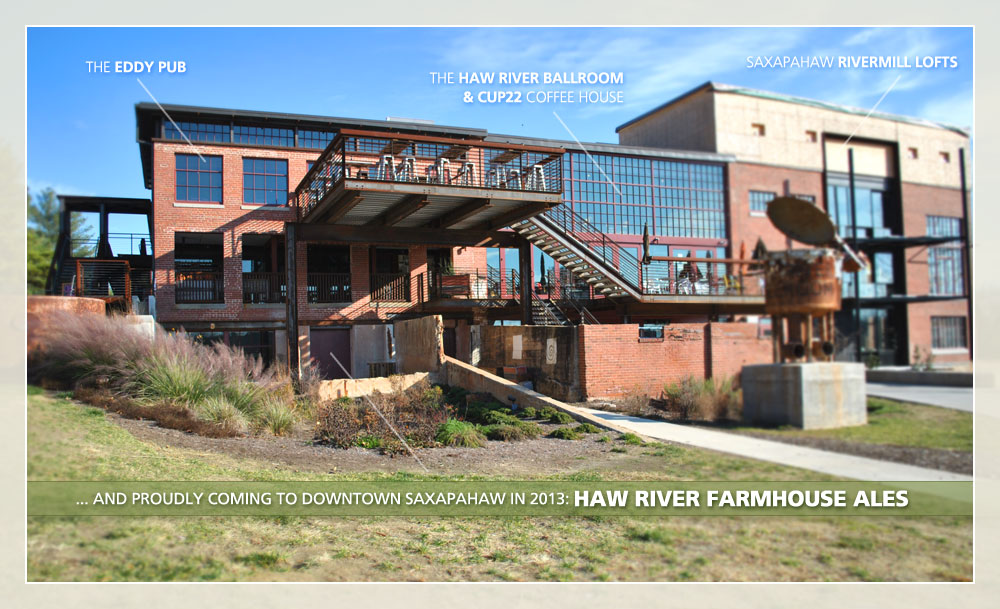
Haw River Farmhouse Ales is proud to be the newest member of
the Saxapahaw business community. Can't wait to open in 2013!

(click this image to take a little closer look...)

Just last week, we signed a three year lease on the space that will become Haw River Farmhouse Ales in 2013, smack dab in the middle of our hometown of Saxapahaw, NC. Our new 3000 sqft+ home is located in the old Dye House building directly below The Eddy Pub, and just alongside The Haw River Ballroom, the Saxapahaw General Store and a number of other great neighbors. The majestic Haw River itself tumbles by just two hundred feet south from what will become our little outdoor seating area.

The recently restored building is an admirable testament to our hopes and plans with the brewery buildout and operation—it's geothermally heated, has solar arrays atop the roof, and is itself a reclaimed existing structure that utilizes found objects from the old mill as a number of its structural components. To say we're really excited about our location is a rather dramatic understatement—we cannot wait to show each and every one of you what we have planned for this space.

So stay tuned, everyone! We've got some really awesome ideas for the experience we know you'll love, and as we move forward designing the space and building out the brewery, we'll make sure to post photos, videos, updates and more, to help keep you in the loop and let you know how things are progressing! We're working hard to get beer in your glasses as soon as we can!! Please let us know if you'd like to come out to take a look in person or if you ever find yourself in Saxapahaw. We're always happy to have you swing by to say hello!

Tuesday, November 20, 2012

What Are You Thankful For?

We just wanted to take a moment out of our admittedly busy schedule to tell all of you something we've been meaning to say for quite some time:

Thank you.

Thank You, those of you who have liked us on Facebook or followed us on Twitter, and those of you who have told your friends and families about what we have planned when we open our doors here in Saxapahaw in 2013.

Thank You, those of you who have come out to our pouring events over the past year or two to learn more about Haw River Farmhouse Ales and try samples of our beer, and to those of you who have come back for seconds and thirds.

A ridiculously big Thank You to our 42 Barn Raisers, who have put your money where your heart is and supported our idea financially, before we've even signed our lease or ordered our equipment. Your loyal enthusiasm for what we're doing means more than we can put into words.

Thank You to those of you in the midst of the North Carolina craft beer scene who have written online or in print about us, who have told other craft aficionados what we're working on, who have bragged online about getting a bottle or two of our beer and shared photos and descriptions of our libations with your friends.

Thank You to the farmers, vendors, landowners and local residents here in Alamance County who have made time in your own busy schedules to speak with us about growing some of our ingredients, about sourcing equipment and supplies, about pitching in next year when we get our doors open by cleaning kegs, filling growlers or working the booth at an event.

Thank You, bartenders, restauranteurs, shop owners and buyers who have already let us know they'd like to carry Haw River Farmhouse Ales' tap handles, our bottles, our growlers, once we get kegs & bottles filled next year and get beer out the door and into your glasses.

And finally, a big Thank You to the brewers and business owners who have entertained many of our dumb questions with straight faces, who have offered to let us peek behind their doors, and who have selflessly provided information that most other industries would consider taboo—the craft beer industry is the very definition of altruistic, and for that, we're so thankful.

So this Thanksgiving, we both just want to say THANK YOU to each and every one of you reading this right now. Without you, we wouldn't even be close to realizing our dreams or becoming what we hope will become a compelling, complementary addition to the thriving North Carolina beer family, and we want you to know we're ever so appreciative of everyone out there who's been a part of this journey so far.

—Ben & Dawnya

PS: Just so ya know, we're about to kick this baby into high gear, so all of you who have been waiting for news on where the brewery's going to be, what the timeline on our opening is, and just what the heck has been going on for the past six months or so are in for a real treat. For now, enjoy a nice meal with the extended family, and we'll fill you in within the next couple of weeks; from where we're standing, 2013's gonna be a big year for Haw River Farmhouse Ales filled with fun and awesomeness, and we hope you'll be along for the ride.

PPS: Don't forget that North Carolina beer pairs wonderfully with both green bean casserole and annoying in-laws! Have a great Thanksgiving!


Friday, November 9, 2012

Put that Spent Grain to Use!

A few weeks ago, Haw River Farmhouse Ales was lucky enough to have been invited to pour our beer alongside some of the most promising upstart breweries in the state, helping to raise funds to benefit the Triangle's oldest no-kill animal shelter, Second Chance Pet Adoptions. The awesome folks at Steel String Craft Brewery, Deep River Brewing Company, Four Saints Brewing Company and newcomers to the scene, Raleigh Brewing Company and Crank Arm Brewery, were all in attendance at Rockfish Seafood Grill in Durham for a night of great beer and great people.


As part of the effort, each of the breweries made dog biscuits from the spent grain left over from our batches of beer, and then made them available to attendees who made a $2 donation to the cause. Our treats went over like gangbusters, and we had a couple folks ask for the recipe, so here you go. Needless to say, you can easily double or triple the recipe (we needed a bunch for the event, but they keep pretty well):

• 2 cups spent grain (just make sure there are no hops included... hops are poisonous to dogs)
• 1 cup unbleached flour
• 1/2 cup natural peanut butter (make sure you include any of the oil as well)

• 1 egg

Mix ingredients thoroughly (don't be afraid to use your hands, to help to make sure everything's distributed well). Press into a large baking sheet (or two, if you're doubling the recipe) in a dense, consistent layer about 1/4"-1/2" thick. Score into the shapes you want (or use a cookie cutter shaped like a dog bone or something fun; Martha Stewart, of all people, has some that come in a few sizes that you can get at PetSmart) and bake at 350F for 30 minutes. After a half hour, take the sheet(s) out and cut all the way through the score marks to completely separate the individual treats, then bake at 225F for an hour. Brush each with an egg wash on the tops & sides, then bake another 3-5 hours or so (depending on how thick they are, how hot your over is, etc) or until dry and completely firm when you press them with your finger (they should feel like, well, a dog biscuit). Turn off the oven and leave the pan(s) in there until they're cooled (this helps to make them as dry and solid as possible).

By the way, for those of you out there who would like to try this recipe, but you've not yet delved into brewing your own beer, you can usually email your local neighborhood brewery and they'll be happy to allow you to swing by to fill a small bucket or two (the raw spent grain freezes well) next time they're cleaning up after a brewday. Or heck, we can always save a little for you next time we brew, as well—feel free to drop a line and we'll set aside a few bags' worth when we next drum up a batch!

Wednesday, May 9, 2012

Our Barn Raiser Fundraising Efforts: A Question & Answer Session

The response to our Barn Raiser fundraising has been humbling so far, as we've had an outpouring of support from both friends and family since we started offering them in January, as well as those who have heard what we have planned with Haw River Farmhouse Ales and are excited about what's in store. We do, however, get questions from folks fairly often asking about why we're selling them, what's included, how they can get one, etc, so we thought it might be helpful to put a little Q&A post together on our blog, to help explain things in a little more detail. If you've heard what we have planned and are interested in helping us get our doors open later his year, but still have questions or comments after reading through things, please don't hesitate to drop us an email and let us know. We love hearing from the folks in our community!

With your help, our Barn Raiser Founders Collections
will help us fund part of our brewery when we open later this year.

What the heck is a Barn Raiser?
We're planning to open our brewery a little later this year and are currently in the external "fundraising" portion of the start-up phase. And while a lot of our friends and peers starting up their own breweries decided that crowd-funding websites (such as Kickstarter or IndieGoGo) would be the best route to take for raising a few dollars, we decided we wanted to take on a more independent approach and offer custom, unique collections of high-end merchandise and one-of-a-kind opportunities for craft beer aficionados and small business supporters here in our community.

Why are you guys selling them?
We wanted to give our supporters the opportunity to get their hands on some unique and limited-edition stuff before we get our doors open, and we thought this might be an interesting alternative to the crowd-funding sites we mentioned above that have gained popularity lately. The revenue raised will help us bridge a gap in our start-up budget, of course, and allows us to keep our fundraising a little closer to the community than simply going to a bank and signing on for a big ol' loan. The money brought in from our Barn Raisers certainly won't fund our entire brewery, but it's a great way for us to set aside a little chunk of what we're doing and share it with our community.

I want to support what you're doing, but those prices look a bit steep for my budget. Anything else I can do to help?
First off, we're touched that this question actually does come up rather often at our events and public pourings—to have our friends tell us they want to give us financial assistance and be involved, but that we've not provided them the opportunity, is humbling, to say the least. And we never meant to exclude some of our closest friends and supporters by creating packages that included levels of merchandise that raise the price point a bit high. So we've heard your concerns and have decided to offer a smaller level we're calling the Barn Raiser Enthusiast, which should be available by the time you're reading this! We can't do it without every single one of you, so we want to make sure you can hop on board with us from the beginning and join the fun!

So what's in each of the "levels", and how are they different?
We started with two levels (the Barn Raiser Founder and Barn Raiser Premium) around the beginning of the year and have just released a third, less-expensive option in May, the Barn Raiser Enthusiast, for those folks who have expressed interest in what we're offering, but have a little more of a modest budget. Take a look below for a run-down of everything we include in each of the collections!

The Barn Raiser Enthusiast
Our Barn Raiser Enthusiast includes your very own Barn Raiser's t-shirt (a different cut and shirt design are available for men or women), an imprinted Belgian-style footed glass, a Barn Raising Founder certificate, a set of exclusive stickers and a single admission ticket to our private Barn Raiser's Founders party to be held before we open to the public. The perfect size for the beer lover in your life, our Barn Raiser Enthusiast is being sold for only $95.

The Barn Raiser Founder
Our Barn Raiser Founder includes everything in the Enthusiast, as well as an extra Belgian-style tulip glass, a set of unique stoneware coasters in a hand-numbered gift box, a wall-mounted bottle opener, a two-year membership to our Barn Raiser Founder's Club (which gets you discounts on merchandise, exclusive growler fills, special access to bottle releases, and much more once we're open), and a hand-numbered raffle ticket for the chance to win a day in the brewhouse (brewing a batch of your very own beer that will be sold in bottles, with 100% of the profits being donated to the 501c3 of your choice). The Barn Raiser Founder is a great choice for that special craft beer lover or drinkin' buddy in your life and sells for only $295.

The Barn Raiser Premium

Finally, our Barn Raiser Premium includes everything in the other two boxes, as well as an extra admission ticket to our private Barn Raiser's party, an extra raffle ticket for two chances to win a day in the brewhouse and a donation to the charity of your choice, a second Barn Raiser t-shirt (so you can have one for "him" and one for "her"), a piece of original art from our very awesome illustrator Nathan Golub, a wood wall-hanging with custom artwork you can display in your home, a lifetime membership to our Barn Raiser Founder's Club, and a single bottle of the very rare, very exclusive beer we'll have on tap at the private Barn Raiser's party, so you can bring home a little something special to age or share with friends! This one's the Cadillac of Barn Raisers for couples or the true craft beer aficionado, and sells for only $495.

What makes a shirt and a couple of coasters so special?
Every piece included in each box has been designed exclusively for inclusion in our Barn Raiser Collections, and will only be available to those who get in from the start and never be sold separately at any other point. We hope this helps add value to the pieces we've chosen to include in each of our Barn Raiser boxes.

Can't I just buy one of those nifty (shirts, glasses, coasters, stickers, et al) separately?
We'd love to, of course, but we think it wouldn't necessarily be fair to the Barn Raiser Founders who have supported us by investing in a full Barn Raiser box. We love the fact that so many friends and fans want to help us out, so we've tried to make it a bit more approachable by creating a smaller Collection for a more nominal price. If that's outside your price range, we'd certainly appreciate you letting your friends know about what we're doing, becoming our fan on Facebook or following us on Twitter, and seeing you come out to one of our future pouring events around the Triangle and Triad regions of NC!

What is the money raised by sales of the Barn Raiser Collections being put toward?
Every dollar raised by our Barn Raisers goes toward our general start-up budget, which includes budgeting for brewhouse equipment, ingredients, oak barrels and fermenters, operating costs, and more. We're also in discussions with a few local farmers to set up contracts with them to grow some of our ingredients, so your contribution will help us achieve some of our sustainability and local sourcing goals as well.

Are you actually "raising a barn"?
That's certainly our plan in the long-term, but our initial location when our doors open this year won't be a barn just yet. We expect to set up shop in a very cool centralized location here in Saxapahaw (details on our location are almost finalized, so sign up for our mailing list and keep an eye out for our announcement very, very soon!), and then organically grow into both our brand and our permanent home over the next few years, to the point where we can build our own barn/brewery/taproom on the edge of town when it's financially and feasibly sound.

Sounds fun. I'm in! Where the heck can I buy one?
First off, we think you're awesome. Now that that's been made clear, you can simply head to our online store over at hawriverales.bigcartel.com, select the level of Barn Raiser you'd like to purchase, and then we'll get everything packed up and shipped to you for free within a couple days of your order!

Now that we've had a chance to explain some of the details involved with our Barn Raisers, we want to hear from you! Still got questions about what we're doing? Comments? Complaints? We want to you to drop us a line! If you like where we're headed and you think you may have friends who would also be interested, please feel free to forward this page to them or suggest they follow us on Facebook. Like we said earlier, we can't do this without you, and we appreciate every ounce of support from each and every one of you!

Wednesday, May 2, 2012

The Beast from the Yeast is Growing!

Since we started our wild yeast collection experiment a few months ago, we've had more than a few folks contact us via email or approach us at events and mention they'd noticed us because of our blog post or heard someone discussing what we're doing. Seems there's a lot of interest from a range of different folks about what we're attempting to do, and from what we can tell, most of you are as excited as we are about what we're hoping to find.

Recently, we were lucky enough to have been invited to pour at Homebrewed Raleigh, alongside our friends at Carrboro's very own Steel String Brewery and a number of awesomely talented homebrewers from around the Triangle area. During the second session of the event, an enthusiastic couple came by our table to try the beer we were pouring (we brought a cask of our Farmhouse IPA, a hoppy Witbier and a special Spring version of our Saison, made with locally-malted barley from our friends at Riverbend Malt House in Asheville, NC) and mentioned they'd read the earlier blog post about our little experiment. As the conversation continued, we learned that one of them currently works at a local university as a research specialist, spending a majority of her time watching yeast cells under a microscope (serendipity is a clever creature sometimes, no? :) After hearing her questions and concerns about what we had planned (I believe her words were along the lines of "you'll want to try not to kill anybody with that..." but I digress), we decided it made a bit more sense to have our new friend take a look at our collected samples and give us her feedback and advice.

Each of the four vials were collected from spots
around Saxapahaw, NC a few months ago.

So here's a little update on where we are with the experiment these days. Last weekend, we handed off 4 vials of our wild yeast cultures to our new friend, so she can plate each of them, freeze down a sample on a variety of media, and then move forward isolating individual strains that potentially exhibit the qualities we're looking for in a brewer's yeast (the amount of sugar the yeast will eat [called "attenuation"], the alcohol tolerance of the particular strain, the ability for it to clump together and fall out of solution [called "flocculation"] after it's done doing its thing...). Right now, there exists in each vial a miasma of all kinds of living beasts (some friendly, some a bit more dastardly), so it's important to try to grow up single colonies of yeast cells in an effort to tell them apart and separate each of them into individual "neighborhoods", so we can really see what we're looking at, and (down the road) pitch the right amounts of each type into the beer we're making. Did I mention I'm glad we now have help with this?

This is an example of Brettanomyces Bruxellensis,
one of a many organisms we're hoping to find in our samples.

Once the strains are isolated and we can actually take a look at pure cultures, we're going to get DNA sequenced for the ones we want (so we can potentially identify them and match them up with existing strains), then pull a few into a very simple beer recipe (90-100% base malt, with a little specialty malt thrown in for a bit of body & sweetness, depending on the types of yeast we end up with and are testing out). These will be split evenly into a number of small fermenters, so we can let the aroma and flavor qualities of the yeast shine and see what we've got. We'll ferment the beer out and measure the sugars, and then analyze the results from a number of angles.

If we end up with an appealing outcome, we're hoping we can bank the yeast(s) with a service such as the one White Labs offers, and then be able to order that particular strain whenever we want to brew a new batch of a particular style. It'll be like having our own unique library of Saxapahaw yeast to use for the beer we make!

A secondary goal we have is to be able to gather data on what true spontaneous fermentation here in central North Carolina might look like, and then collect the data we need to attempt to control certain aspects of the process for a future batch of wild fermented lambic. But coolships and spontaneous fermentation is a subject worthy of another blog post. Stay tuned, folks—this is getting fun. ;)

Friday, March 9, 2012

The Beast from the Yeast

Those of you who follow us on Facebook (what, not you? Shame on you...) may have heard about a little wild yeast experiment we're currently working on. While the planning for the brewery is going well and finally moving forward after a few months of arduous location scouting (we'll have another blog post with details on this one very soon), we've been working on harvesting some wild yeast from our hometown of Saxapahaw, NC, as both a nod to our Belgian brethren across the pond and an exploration of just how "local" we can attempt to create a beer recipe.

A little birds-eye perspective on where we placed each of our collectors.

Our experiment began a few weeks ago by creating 3000mL of "starter wort" using carbon-filtered water and several ounces of light DME (that's basically a sugar water made from dried malt powder and a little yeast nutrient thrown in for good measure). We acquired a few small Pyrex containers and removed the center of the plastic lid with a utility knife, so we could "seal" the container but leave a nice big hole in the top to let the bugs in. We then sanitized the containers along with some cheesecloth and assembled each of our "yeast traps" by adding the wort, placing the cheesecloth across the top, then sealing the whole thing with the lid, leaving a nice, big, open hole in each for the yeast (and other things) to come on through. With the containers filled and prepared, we ventured out to a few spots in Saxapahaw to see what we could harvest.

The fig tree atop the hill
where Saturdays in Saxapahaw
is held each summer.
Sample A was placed beneath the fig tree that sits atop the hill overlooking the spot where Saxapahaw hosts its Saturdays in Saxapahaw events each summer (if you haven't been to one, you're missing out — follow SXPHW on Facebook for the upcoming schedule, which always includes really great bands every weekend). It's a little early for the tree to bear fruit, of course, but we wanted to see if some of the yeast might live there in the "off season", as it were.

The fireplace just off the Haw River,
south of the Rivermill apartments.
Sample B was brought in from a small perch on a stone wall just off the bank of the Haw River, which runs directly through Saxapahaw on its way down to Jordan Lake (then the Cape Fear River, then the Atlantic Ocean). Our hope with this one was to find out if the flow of the river might bring interesting things from the west, where it starts all the way from around Kernersville, NC. (Incidentally, when we picked this one up after a couple days' exposure, it looked like some wild critter — a raccoon perhaps? — had tried to get at the sweet wort inside. Luckily, the cheesecloth held fast and the varmint was deterred).

On the stone wall that surrounds
the patio upstairs at the Rivermill.
Sample C was placed just a bit closer to home, on the wall that surrounds the patio just outside the door of our apartment. We figured this was a nice, central location that would provide pretty reliable exposure from a number of different sources from all over Saxapahaw. Plus it was easier to keep an eye on it.

And Sample D we decided to actually leave inside our apartment, on the windowsill, just to find out if the "funk" might differ between inside and outside. Didn't have much hope for this one, but when we collected it after a few days, we were pleasantly surprised with a tart, floral, bready aroma.

After a few days of leaving our containers out in the cool, dry weather, we collected our samples, brought them inside, then transferred each of them into their own sanitized glass container (removing any mold that had gained purchase on the surface so as to try to cut down on too many off flavors or harmful bacteria from the start). Each container was covered with sanitized aluminum foil, so there'd be a bit of oxygen transfer to allow any yeast to grow a bit longer, then left alone to settle out.

After a few more days at room temperature, we made another "starter batch" of our DME-wort (twice as much this time), then pitched each wild yeast starter into sanitized half-gallon growlers with air-locks, like you see in the photo below.

Our wild yeast samples, safe and sound back at the homestead.
It's been a few weeks as of the time of this post, and so far, we've got fantastic growth in our "Fig Tree" sample and moderate growth in the Windowsill container (strangely enough). None of the samples have much of an off-aroma (none of them can safely be tasted just yet, just in case anything dangerous is present, which should be killed over the next few weeks as the pH drops in the samples), with the River and Windowsill samples smelling the cleanest (a varying degree of lemony, tart, spiceiness in each) so far. As things progress, we'll document in more detail the difference between each, and what we notice in the appearance, aroma and (eventually) taste of each sample.

Keep an eye on our Facebook page and this blog for a follow-up post over the next few weeks, spotlighting what we discover when we get these beasties grown up a bit more and under a microscope! Assuming we can get viable yeast from one (or all!) of our samples, we're planning to brew something rather special to be placed in a very cool 10g cask we picked up from one of our favorite beer bars in Raleigh a few weeks ago. Stay tuned, wild beer fans!

Postscript: In case you're wondering, the little note on each container says "Please don't drink me, disturb me or throw me away. I'm a yeast experiment left by someone who lives in the Rivermill Apartments. Thanks!"

Friday, September 2, 2011

(We recently sat down to speak with Charles Sanville, a beer blogger here in North Carolina who publishes through the website brewthebeer.com. What follows is probably the most complete collection of public details on our upcoming brewery we've had the chance to get "on paper" so far, so we hope you enjoy it. And thanks again to Charles for the effort. Make sure to check out his blog, Facebook page, Twitter feed, et al, when you get the chance. — Ben)

At a recent Girls Pint Out event (yes I was at a Girls Pint Out event), I met Ben from Haw River Farmhouse Ales. I didn’t realize that he was the man behind Haw River Ales. First let me say that Ben is a really nice guy, and knows a TON about beer. I guess you would expect that from a brewer. We chatted up a bit, and he gave me some test batch beers to try. To be honest, I felt super cool getting a sneak peak batch of beers.

I set up a tasting event with some of my good beer friends. We enjoyed the tasting, and as Ben asked, wrote some reviews for him. That spurred some questions that I wanted to ask Ben, about his brewery, beer tastes, and about himself.

Top Secret test batch of Haw River's beer
What was your initial inspiration for starting Haw River Farmhouse Ales? 
I’ve always been fascinated by creating things, and the artistic and technical craft that goes into creating a beer is a challenging and rewarding endeavor. There are so many fine details that go into choosing the ingredients, selecting the methods, tweaking the process and then wrapping it all up in a package that the beer drinker will appreciate and enjoy as a final step in the process… that’s something special. The history and culture of Belgian beer has always fascinated me as well. I thought it’d be fun to explore a style the local scene has only touched upon so far, and maybe add a little twist to make it a true North Carolina brewery. 
 
You're in the test stages now. How have your beers been received?
Pretty well, even from folks who don’t know us on a personal level (which accounts for something, in my mind). We’ve had a few “not hoppy enough” comments, and a few “too sour” comments on some of our wild beers, but our goal is to craft a range of enjoyable beers that will be approachable to your everyday beer drinker, but still appreciated by the craft beer lover.
 
That said, we’re working on some recipes that really try to push some boundaries with sour beers and hybrid styles for the area. There are a few North Carolina breweries that are getting into some barrel-aging and sour brewing, and we want to forge ahead with similar goals, hopefully working in tandem with a few of them and helping to create a “southern brand” for the North Carolina craft beer scene.
 
When did you start brewing?
I brewed my first batch a few years ago (a sweet stout in a 3-gallon pressure cooker pot my mom lent me), but didn’t start really ramping up my craft until last year, to be honest. Since we had an inkling of potentially turning this into a business, I’ve been brewing two or three times a week, trying variations on some of our favorite recipes so they fit in with the goals for the brewery, and working on balancing certain local ingredients for some interesting flavor profiles. Brewing so often is a great way to perfect the craft from a technical standpoint — the only downside is you end up with a LOT of beer. Let’s just say the good folks of Saxapahaw have been a great avenue to help “dispose of” a lot of extra beer that we’ve found ourselves with lately.
 
When did you know it was time to take the next step from home brewing to more of a micro brewery?
I like to jump head-first into just about everything I attempt, so I figured if I dug brewing beer, it made sense to make a business out of it , so we can bring other people into the circle to enjoy what we’re doing (and yeah, I can hear all the brewery owners out there laughing now, since it’s fairly well-known that the last thing you should do is open a brewery if you actually enjoy, you know, BREWING beer). Plus, I’d spent a decade sitting behind a computer as a graphic designer, so after I sold my company to my former business partners last year, I figured this was the right time to jump. 
 
Why farmhouse ales?
A couple of reasons: First, they’ve always been a personal favorite of mine. The best versions you can find are a delicate balance between the peppery fruit and a clean crispness on the palate, with just a little touch of musty funk mixed in for good measure. Both brewing them and drinking them has always been a great experience for me — when I walk into a brewpub for the first time, the first beer I search their list for is some sort of saison (farmhouse ale).
 
The second reason is that we call the beautiful town of Saxapahaw, North Carolina our home. If you haven’t driven out to Sax or through Alamance County lately, head on out. A farmhouse brewery seemed to make perfect sense near our hometown, and it’ll allow us to use some fantastic locally-grown ingredients in our beer for what we hope will be a unique experience.
 
And third, the term “farmhouse ale” is accepted to be a pretty open-ended definition within the craft beer community, so it’ll allow us to do some interesting and engaging things with our beers in the future. Let’s just say the test batches we’ve sent out so far are samples of our flagship beers we’ll brew year round and have on tap around the clock… we’ve got a ton of ideas for side-projects, one-offs and collaborations planned that should push a few boundaries, hopefully.
 
Where do you get ingredients from? 
The honey used in our Farmhouse Saison comes from a few beekeepers close to home in Alamance and Orange Counties (depending on which batch we’re brewing). We’re also talking with a few NC-based farmers and gardeners to find out to what capacity we can source local ingredients, once we’re up and running. One idea we have for our monthly brewery tour is to eventually take folks by bus to all the farms and locations we partner with to grow and prepare our ingredients, so they can get a good look at what a field of barley looks like, how hop cones feel growing on the bine and what it takes to get honey from a beehive. After the tour, we’ll all head back to the Haw River taproom to try samples of the resulting beers, made from the raw ingredients everyone just witnessed. That’s what I call local — I think folks might appreciate that and get something new out of it they’ll remember. Hell, even the cotton used by TS Designs in Burlington, NC to make our “Drink Southern” t-shirts was grown here in North Carolina. We dig local.
 
What is your vision for Haw River? Small and local? More of a tap house? Distribution only? Kegs and bottles?
We definitely want to stay relatively small, probably within state lines, for the most part. I could talk for an hour about my assumptions on the craft beer industry as a whole, how it seems to be moving incredibly local (incredibly fast, in my opinion) recently, but I’ll save that for another day. We’ll have a taphouse/brewpub eventually (we’ve got some great ideas), but we’ll probably start with a small production facility here near homebase, so we can start getting our beer out there in and in folks’ glasses as soon as possible. And we’re planning plenty of draft accounts for now, so our beers should be available at your local favorite beer bar starting around the middle of next year.
 
In addition, we’re planning to package and bottle-condition each of our four flagship beers for sale in local bottle shops and a few grocery stores, so our fans can try a slightly different version of their favorite Haw River Farmhouse Ales they usually get on tap. In addition, we have some really innovative ideas for a side-project series or two that celebrate North Carolina history and culture, and help raise some awareness for some great causes; these efforts we plan to package in traditional corked & caged 750ml bottles, and should be available in your local bottle shop late next year.
 
Is there anyone else that is involved with Haw River Brewing?
We have a few people built into the business plan, but they’ve all still got real jobs, so I have to be careful about what we let out of the bag just yet. Just know that we’re working on surrounding ourselves with smart folks who know all the things I don’t (which I’ve found is an aggressively mutating list). I’ve got thick skin, and I ain’t too proud to bring someone in to handle a task if they’re better at it than I. Had to learn that the hard way with my last company, so I’m making sure we do this one right. 
 
What role are they playing?
One of the shortcomings I personally have is that I don’t have much hands-on experience in a full-size production brewery setting — that’s one of the first details we’re working to establish with our setup. I’m an idea guy, not an engineer, so I want to make sure my time is better spent every day than trying to figure out why the motor on a pump pushing wort into a fermenter isn’t working correctly. We’re also working on putting a fairly informal Advisory Board to meet twice a year to review our progress and make suggestions on where we are and what we have planned. And we have a friend in the business who may serve as our sustainability consultant, offering insight into greywater systems, alternative energy sources and how they might integrate with our daily process, and reducing our waste and carbon footprint. 
 
What is your current favorite beer? Yours or otherwise
This one’s always a stumper. There are just too many to pick one. Even if you don’t like every beer out there, they still can be appreciated for what they are. Of the beers Haw River brews, the Belgian-style IPA is my “go-to”, probably. The last one I remember stopping me in my tracks (literally) was Duck Rabbit’s End of Reason (on cask at The Thirsty Monk earlier this year… man, if I could go back in time…). According to Untappd, it’s a tie between Terrapin’s Rye Pale and Fullsteam’s Rocket Science IPA, which are both remarkably delicious beers to me. Not much of a beer geek answer, I guess… Those are just a couple of damned good beers. 
 
Is there 1 beer that made you want to brew your own?
My first sour was a Monk’s Cafe Flemish Red, and it’s arguably the catalyst that led to what we’re doing today with Haw River Farmhouse Ales. That beer (and just about every wild or sour beer afterward) amazed me with its myriad layers of complexity and depth. I always liked to take things apart and build them back together when I was a kid (I once collected bones from the family dinner table for several weeks in an attempt to glue back together a complete chicken skeleton…), so I guess it goes back to trying to figure out that Monk’s sour. I wanted to find out how to build something for myself as complex as a well-crafted sour beer.
 
Any crazy beer stories? That you want to share anyway?
There’s always the possibility that my mother will read this, so let me skip a few from my earlier days…. This one’s certainly not the craziest thing in my resume that involves beer, but this past spring, my girlfriend Dawnya and I took two weeks off from life and drove 3500 miles throughout the northeast US to visit about 3 dozen breweries, brewpubs, farms and bottle shops, starting at Fullsteam in Durham and ending up at Three Floyds in Chicago (by way of Philly, Cooperstown and Grand Rapids, MI). Our goal was to meet as many beer folks as possible and try as many new beers as we could, and we had an awesome time and learned tons from all kinds of really awesome, really humble people, most of which will influence at least some small part of Haw River Farmhouse Ales along the way, I’m sure. (You can read about our trip in more detail elsewhere on our blog, if you'd like. ^Ben)
 
When can we expect to see Haw River in stores, bars?
We’re aiming for a grand opening party on Memorial Day weekend next year, but it’s important we do everything right, so there’s no huge rush on our end — we’re considering Memorial Day 2012 our floating target. Between then and now, we’re discussing with a number of bars and bottle shops eventual plans to carry our beer, so as soon as we know when they’ll hit shelves and taps, you guys will know. 
 
I gotta ask, who designed your logo. I LOVE it!
Ha. My former life was as a graphic designer, so that was one of the first things I knocked out once we decided on the name. The farmer illustrations, however, come from the talented Mr. Nathan Golub, an old friend I was lucky enough to bring on to projects every once in awhile at my old company. Nathan’s on staff at the Independent Weekly in Raleigh, so if you’re lucky, you can catch some of his work gracing the cover of the Indy from time to time. Guy’s got mad talent… can’t wait to see what he does once we have actual labels and brand needs when we’re up and running.
 
Anything else you want your fans to know?
North Carolina has been my home for almost 35 years, and I love how the craft beer industry has evolved and matured over the past few. I hope whatever we bring to the table with Haw River Farmhouse Ales helps to elevate North Carolina’s place in the craft beer world, and provides our friends and neighbors with a memorable experience every day.
 
Like I said, this logo is cool.

Thanks, Ben, for some great insight on what Haw River Farmhouse Ales is all about. Be sure to follow Ben and everything Haw Rives Farmhouse Ales:
• HawRiverAles.com
Oh, and check out his “Drink Southern” T-shirts! Post it up, if you have any questions for Ben.
— Charles (BrewTheBeer.com)

Tuesday, July 19, 2011

Which Came First, the Chick or the Beer?

I hadn't planned on discussing this much via the blog, since a few friends in the industry have already weighed in with some great points (see Top Fermented and Food Sweat & Beers). But then Monday morning, I sat down with my cup of coffee and saw this article, which leads me to believe this recent trend of misled "feminization" of craft beer may be starting to get some roots. So what the hell, I'll throw in my two cents.


First off, in most cases, I'm opposed to the idea of just about anything being marketed as "women-friendly" (and full disclosure, until recently, I owned a small design & marketing company in Apex, NC for about a decade—whether that works in my favor or against is, I guess, up to you). Most women I know can take care of themselves without being coddled with some watered-down (literally, in the case of "girl beer") softened version of what "us tough guys" like to enjoy. I personally know some bad-ass chicks with great taste in beer (and on the flip side, I know plenty of guys whose libation of choice is Coors Light), and the same people, whether they wear heels or not, that will pick up a six-pack of Chick Beer are the same ones who step up to the bar to order a Michelob Ultra without even asking what's on tap. Certainly nothing wrong with that (I'm an equal-opportunity beer lover), but I don't hear too many women complaining about how their beloved Mich Ultra is giving them gas on a nightly basis and wish someone would come out with some other "delicious beer that was ya know, sorta like Bud 55, but, you know, like… less bubbly, kinda? Tee, hee, hee…".

Not to mention the name. I get it, I do. You're throwing it back in the face of the folks who refer to light, lousy, watered-down beer as "chick beer". Ha, ha. So if that's actually the case, why then did you decide to produce yet another light, lousy, watered-down beer and slap this ever-so-witty name on it? Oops. Looks like you fell backward into the hole you just dug.


The way I see it, these decisions, in general, are usually made just like you might picture: at polished tables full of Marketing People®, who shove a bunch of what other polls tell them is "beer" in front of an Optimally Diverse® group of females, then ask them all questions afterward (either that, or someone without a clue comes up with an idea they think is awesome, and no one tells them otherwise, for whatever reason). "This one doesn't like dark beer, so Our New Product® should be light." "This one has gas, so let's make Our New Product® less carbonated". That sorta thing. Most boardrooms' marketing decisions are based on stats and surveys (even, sadly, on a smaller firm's basis) or even worse, the client's whims, instead of common sense, creative experience or real guts. Of course, it's much easier for a small brewery to try a batch of something interesting, market it toward women (if and however they decide to do so), and then figure out whether it's a success or not. Or even better, most small craft brewers I know just make good beer that PEOPLE love, no matter how many X chromosomes they may have been born with.

When we open next year, Haw River Farmhouse Ales intends to brew Belgian- and French-style beers (with a little Southern flair, of course), many of which may appeal more toward women than others (our flagship Saison is delicious, ladies!). If the Ad Wizards that came up with Chick Beer would have looked into actual existing styles of craft beer and who enjoys actually drinking them (or hell, I don't know… off the top of my head, walk around GABF for a couple days with a list of all the vendors' offerings and ask those of the fairer sex which they consider their favorite), they might be onto something. I know plenty of women that will choose a Bell's Oarsman or a Dogfish Head Festina Peche over a MGD64 any ol' day, so why couldn't Chick Beer be based on a Berliner Weisse, for example?


I don't have the stats in front of me, but if I had to guess, I'd say that more women drink wine than men. So instead of targeting a portion of the potential craft beer market that happen to be women, why not reach those same customers by targeting your campaign to wine drinkers? Or recreational runners? Or teachers? Or graphic designers? Some of these might seem silly, but you get the idea: they're all areas where the percentages of women either exceed those of men, have increased greatly in the past few decades, or at least outweigh the current market segment women hold within the craft beer audience (which, according to Chick Beer, is 25% of all craft beer drinkers). By treating women like, you know, actual people who have interests and judgement, you can target the women for which you're aiming, but without speaking down to them or playing into the (already) tired cliche of pink bottles filled with flat, flavorless beer.

Sit tight, gals. We're planning to open Haw River's doors next Memorial Day, and we'll have plenty of great beer I think you'll like. Although it probably won't have strawberries floating in it… is that okay?